




A scalp vein set is the cheapest device in the infusion chain and the one that decides whether a short cannulation succeeds. Its size is fixed by two numbers that buyers and clinicians often treat as one: the gauge, which sets the outer diameter, and the length, which sets how deep the tip sits.
This guide gives the full gauge and color chart from 18G to 27G against ISO 6009, what each size is used for in adults and in children, and the specifications worth fixing before you request samples.
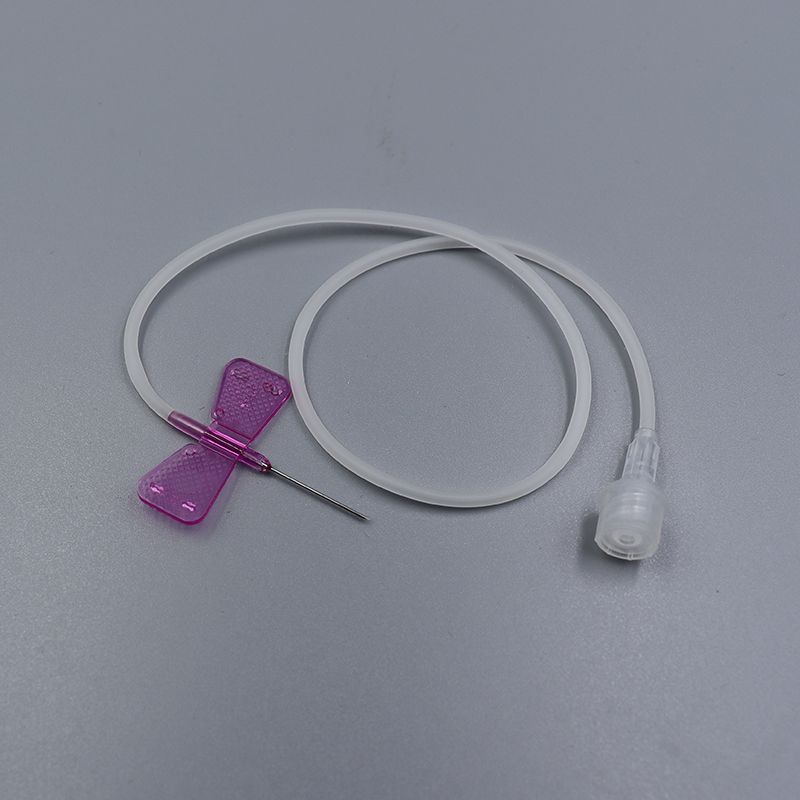
What Is a Scalp Vein Set?
A scalp vein set is a short, thin-walled needle mounted on two flexible plastic wings, with a length of transparent tubing running to a luer connector. The wings give the user a grip close to the puncture point; the tubing isolates the needle from the movement of the syringe or collection tube, which is what keeps a shallow vein from being dislodged mid-procedure.
The device has three common names, and they describe the same product:
- Scalp vein set — the term used in much of Asia and in export catalogs
- Butterfly needle — the clinical term in the US and Europe, taken from the shape of the wings
- Winged infusion set — the specification term used in tenders
If you are writing a purchase order, the name alone will not identify the device. Gauge, length, tubing length, connector and safety configuration do. The naming distinction is covered in more detail in our guide to butterfly needles.
Why Gauge Is the Decision That Matters
Gauge is an inverse scale: a higher number is a thinner needle. 18G has the widest bore in the range, 27G the narrowest. That single number drives four outcomes at once:
- Flow rate. Wider bore, faster flow. This is why rapid infusion and transfusion sit at the low-gauge end.
- Vein trauma. Every puncture damages the vessel wall. Thinner needles do less of it, which is why fragile and pediatric veins are accessed with higher gauges.
- Hemolysis risk in blood collection. A bore that is too narrow for the draw forces cells through a restricted path and increases the chance of a compromised sample.
- Patient comfort. Less discomfort with a finer needle, particularly where repeated access is expected.
There is no universally correct size. The correct size is the widest bore the vein will tolerate for the flow the treatment requires, and nothing wider.
Gauge and Color Code Chart: 18G to 27G
Hub colors follow ISO 6009, the international color-coding convention for hypodermic needle identification. The purpose is practical: staff select by color from a tray rather than reading a size printed on a small hub.
| Gauge | Hub color (ISO 6009) | Outer diameter | Primary use |
| 18G | Pink | 1.20 mm | Rapid fluid infusion, transfusion, emergency and trauma |
| 19G | Cream | 1.10 mm | Rapid infusion where 18G is too traumatic, high-volume blood collection |
| 20G | Yellow | 0.90 mm | General IV infusion, medication, transfusion |
| 21G | Green | 0.80 mm | Routine adult infusion and routine adult blood collection |
| 22G | Black | 0.70 mm | Adults with small or fragile veins, short infusions |
| 23G | Blue | 0.60 mm | Pediatric, geriatric, fragile or rolling veins |
| 24G | Medium purple | 0.55 mm | Very small or superficial veins, neonates |
| 25G | Orange | 0.50 mm | Neonatal and delicate veins, low-volume draws |
| 26G | Brown | 0.45 mm | Neonatal and preterm, very low volume |
| 27G | Medium grey | 0.40 mm | Specialized low-volume draws, extremely fragile veins |
Two cautions on using this table.
Color is an identification aid, not a specification. It does not describe length, wall thickness, bevel or sterilization. Read the label and the IFU for those.
Shade descriptions vary between suppliers. The measured colors are defined by ISO 6009, but the words used to describe them are not: 19G appears as cream or light yellow, 23G as blue or deep blue, 27G as medium grey or grey.
Where the wording matters — a tender document, an incoming inspection sheet — write the gauge, not the color name.
Length Is a Separate Specification
Gauge says nothing about how long the needle is. In this device category, lengths commonly run from 19 mm (3/4 inch) to 38 mm (1 1/2 inch).
- Short lengths suit superficial veins, neonates and scalp or hand access.
- Longer lengths are needed where the target vein sits deeper, including in patients with more subcutaneous tissue.
Length is not freely combinable with every gauge, and the available pairings differ between suppliers. Confirm the length options for your chosen gauge at quotation rather than assuming the full matrix.
Which Size for Adults
Most adult procedures fall into one of four situations.
General infusion: 21G or 22G. These two carry the bulk of adult short-term IV work. 21G is the better default where the flow matters; 22G is the gentler choice when the vein is small but still usable.
Blood collection: 21G. Wide enough for an efficient draw without collapsing a modest vein. This is the most common size in outpatient and laboratory settings.
Rapid infusion or transfusion: 18G or 20G. Where volume has to move quickly — emergency, theatre, resuscitation — the wider bore is the point. 19G sits between them and is often overlooked: it keeps most of the flow of an 18G with a slightly smaller puncture, which matters in an older patient who still needs volume.
Fragile, elderly or dehydrated veins: 23G or 24G. Thinner needles reduce the risk of blowing a vein that will not tolerate a larger puncture. The trade-off is a lower achievable flow rate, so this choice has to be checked against what is being infused.
Which Size for Children and Neonates
The same logic applies with less margin. 23G and 24G cover most pediatric work; 25G is the common neonatal size; 26G and 27G are used in preterm and very low-volume situations, including specialized draws.
The constraint that catches people out is the flow ceiling. A 26G will not deliver a rate that a 24G will, and no amount of pressure changes that — it only increases the risk of the tubing or the vein failing. If a pediatric protocol requires both a fine needle and a faster rate, those two requirements are in conflict and the device choice needs to be reconsidered rather than forced.
Safety configuration matters more in this age group than in any other. The safety scalp vein set exists for exactly this reason: a needle that has just been in a moving child is the one most likely to be dropped or mislaid before disposal.
Scalp Vein Set, Butterfly Needle or IV Cannula
The first two are the same device under two names, so the choice between them is a naming convention, not a clinical one. The real decision is between a scalp vein set and a peripheral IV cannula.
| Scalp vein set | IV cannula | |
| Dwell time | Short — procedure or short infusion | Days, with care |
| Approach | Steel needle stays in the vein | Soft plastic catheter indwells |
| Dislodgement risk | Higher if the patient moves freely | Lower |
| Best for | Short access, difficult veins, single procedures | Ongoing therapy, repeat dosing |
| Relative cost | Lower | Higher |
The rule of thumb: if the access will be needed again tomorrow, a cannula is the right device. If it is needed for one procedure, or the veins will not accept a cannula, a scalp vein set is. The comparison is set out in full in scalp vein set vs IV cannula.
Types: Disposable, Safety and Luer Lock
| Type | Defining feature | Typical setting |
| Disposable scalp vein set | Basic needle, wings and tubing | General venipuncture and blood collection |
| Safety scalp vein set | Retraction or shielding mechanism after use | Facilities with a needlestick prevention policy |
| Luer lock scalp vein set | Threaded connector that resists separation | Infusion and pressurized delivery |
The safety version carries a higher unit cost and a training requirement: a mechanism that needs an extra remembered action will eventually be skipped. Whether that premium is justified is a policy question for the facility, not a clinical one. The configurations available in retractable designs are covered in retractable butterfly needles.
What to Specify Before You Order
Most sourcing errors on this device come from a purchase order that names the product but not the configuration. A specification should fix all of the following:
- Gauge and length, stated per line item, in millimeters rather than inches where the destination market uses metric labeling.
- Tubing length, since it varies between suppliers and affects how the set is used at the bedside.
- Connector — luer slip or luer lock, and whether the port must accept a specific infusion system.
- Safety configuration — none, manual retraction or automatic retraction.
- Packing — blister or pouch, units per box, units per carton.
- Labeling — whether the box and pouch can carry your own brand, and in which language.
- Documentation — the regulatory status required for the destination market, confirmed before production rather than after.
Ordering: MOQ, Production and Lead Time
Scalp vein sets are produced to order rather than supplied from stock, and the minimum order quantity is 100,000 pieces.
Made-to-order production changes three things a distributor will notice:
- Shelf life starts at production. Nothing sits in a warehouse before it reaches you, so the usable life on arrival is the full stated life rather than a remainder.
- One order, one lot. Gauge mix, color and packing stay consistent across the shipment, which simplifies incoming inspection and lot release.
- Configuration is yours. Tubing length, connector type, safety mechanism and labeling artwork are fixed at order rather than selected from a catalog.
Lead time depends on the configuration and the quantity, and is confirmed with the quotation. It is not a figure worth publishing as a fixed number, because it moves with the mix.
Safety and Handling
The device is simple; the failure modes are not.
- Use sterile, single-use sets only, and check package integrity before opening.
- Never reuse or rebend a needle. A reshaped bevel cuts rather than separates tissue and does more damage on the second attempt.
- Secure the wings with tape or a dressing. Most dislodgements happen between insertion and the first check, not during the procedure.
- Dispose immediately into a sharps container. The withdrawal moment is when needlestick injuries occur, not insertion.
- Watch for phlebitis, infiltration and extravasation, particularly with irritant drugs and small veins.
Next Step
If you are specifying for a tender, a distributor range or an OEM program, send the gauge, length, tubing, connector and packing you need. We will confirm what is available in each size and quote against your configuration.
Start from the scalp vein set range or request a quote.
21G and 22G cover most adult short-term IV work. 18G or 20G is used where rapid infusion or transfusion is needed, and 23G or 24G where the veins are fragile.
Green, under ISO 6009. 20G is yellow, 22G is black and 23G is blue.
Yes. Scalp vein set, butterfly needle and winged infusion set are three names for the same device. The naming differs by region and by trade usage, not by design.
Outer diameter: 1.20 mm against 0.90 mm. The 18G delivers a higher flow rate and makes a larger puncture, so it is chosen for rapid volume and avoided where the vein is fragile.
Yes, and it is widely used for that purpose. 21G is the routine adult size, with 23G for fragile veins and 25G and above for neonatal draws.
100,000 pieces, produced to order. Configuration, packaging and labeling are fixed at the time of order.
WANT TO WORK WITH US?

Author: EMMA
Marketing Manager
Hello, I'm Emma, serving as the Marketing Manager at Shanghai Teamstand Corporation. With over 10 years' experience in the medical industry. Our dedicated team is eager to offer you good service and high quality products with competitive price.
Mob: (00)86-18621901943
Email: sales@teamstandmed.com
Post time: Nov-04-2025