




Choosing the right Huber needle supplier is important when you are developing a new medical device product line or sourcing for long-term distribution. For hospitals, distributors, and medical device brands, the supplier needs to provide more than a competitive price. Product quality, customization, documentation, production capacity, and delivery reliability all need to be considered.
For OEM and ODM projects, it is also important to evaluate whether the manufacturer can support your requirements from the first sample through mass production.
1. Check Certifications and Regulatory Documentation
Start with the supplier's quality system and regulatory documents. A reliable medical device manufacturer should be able to provide clear and valid documentation for the markets you plan to enter.
Common documents to check include:
- ISO 13485 certification for the medical device quality management system
- CE-related documentation for applicable European markets
- FDA registration and device listing, where applicable
- 510(k) clearance, if the specific product requires and has obtained it for the US market
- Product specifications, test reports, sterilization records, and other supporting documents
It is important to check the actual documents rather than relying only on statements such as "FDA approved" or "CE certified." FDA establishment registration and device listing are not the same as FDA clearance or approval. The FDA states that registration and listing do not by themselves indicate that a facility or device has been approved, cleared, or authorized.
For ISO standards, check which standards actually apply to the product. ISO 10555-6 covers subcutaneous implanted ports and related catheters, but it specifically states that it does not cover non-coring needles.
| Document | What to Check |
|---|---|
| ISO 13485 | Valid certificate and certified scope |
| CE documentation | Applicable product and European regulatory requirements |
| FDA documentation | Registration/listing or 510(k) clearance, as applicable |
| Test reports | Product performance, sterility, packaging, and related tests |
2. Look at OEM/ODM and Product Customization
For an OEM or ODM project, a supplier should be able to adapt the product to your specifications instead of offering only a fixed standard model.
For a Huber needle, possible customization areas include:
- Needle gauge and length
- Straight or 90-degree configuration
- Extension tube length
- Single or dual-lumen configurations
- Injection site options
- Clamp and connector options
- Safety features
- Hub color and labeling
- Sterile pouch and private-label packaging
The needle tip is particularly important. A non-coring Huber needle is designed with a special tip geometry to reduce coring when accessing an implanted port.
Before placing a bulk order, ask the manufacturer for drawings, product specifications, samples, and information about the available customization options.
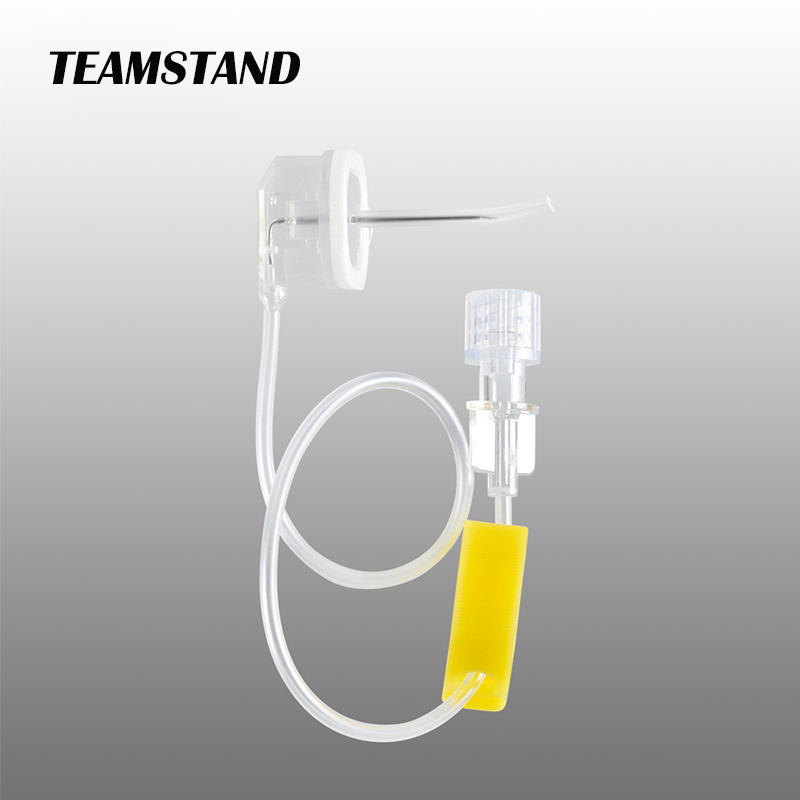
Non-coring Huber needle with extension tubing for port access applications.
3. Check Materials and Manufacturing Conditions
Materials can affect the performance, durability, and compatibility of a disposable Huber needle.
When evaluating a supplier, ask about the materials used for the main components, including:
- Medical-grade stainless steel needle tubing
- Medical-grade plastics for the hub and connectors
- Extension tubing suitable for the intended application
- Latex-free components, if required
- Packaging materials suitable for sterile products
You should also ask where assembly and packaging are performed and how the manufacturer controls the production environment.
A good supplier should be able to explain its material sources, production process, sterilization method, and packaging controls without giving vague answers.
4. Review Quality Control and Product Testing
Quality control should cover the whole manufacturing process, not just the final inspection.
For Huber needles, useful areas to check include:
| Quality Check | Why It Matters |
|---|---|
| Needle tip inspection | Helps control tip quality and consistency |
| Needle dimensions | Ensures the product matches approved specifications |
| Penetration performance | Helps verify suitable port access performance |
| Leakage testing | Checks connections and fluid-path integrity |
| Sterility and packaging | Helps maintain product quality through its shelf life |
| Lot traceability | Makes production batches easier to track and manage |
For OEM projects, ask whether the manufacturer can provide inspection records, test reports, sample approval records, and batch traceability documents.
This is especially important when you plan to sell the product under your own brand.
5. Compare Production Capacity, MOQ, and Lead Time
A supplier may have a good product but still be unsuitable if it cannot meet your purchasing requirements.
Before signing an OEM/ODM agreement, confirm:
- Production capacity
- Standard and customized MOQ
- Sample lead time
- Mass production lead time
- Packaging lead time
- Sterilization arrangements
- Export experience
- Ability to handle repeat orders
If you are launching a new product, flexible MOQ can also be useful because you may want to test the market before moving to large-volume production.
Do not compare suppliers only by unit price. A slightly lower price may not be attractive if it comes with longer lead times, limited customization, or inconsistent quality.
Shanghai Teamstand Corporation for Huber Needle OEM/ODM
Shanghai Teamstand Corporation is a Chinese manufacturer and supplier of disposable medical devices and medical consumables, with product lines covering vascular access, blood collection, injection, and other medical applications.
For buyers looking for a Huber needle supplier for OEM/ODM projects, Teamstand can support requirements such as product specifications, packaging, labeling, and other customization needs.
The company's Huber needle range can include different configurations for port access applications, such as straight and right-angle designs, with options for different gauges, lengths, connectors, and extension tubing according to project requirements.
Teamstand also provides a broader range of vascular access and disposable medical products, which can be useful for distributors looking for a single supplier for multiple product categories.
Why Consider Teamstand for Your OEM/ODM Project?
| Requirement | Teamstand Support |
|---|---|
| Product customization | Needle specifications, configurations, and packaging |
| OEM/ODM | Private-label and project-based customization |
| Quality system | ISO 13485-based quality management |
| Product range | Huber needles, vascular access, and other disposable medical devices |
| Export support | Documentation and international order support |

6. Request Samples Before Bulk Production
Before confirming a large OEM/ODM order, always request samples.
Check the product from both technical and commercial perspectives:
- Needle appearance and tip quality
- Hub and connector design
- Extension tube flexibility
- Packaging and labeling
- Sterile barrier integrity
- Product dimensions
- User handling and overall construction
For customized products, it is also useful to approve a final sample or pre-production sample before mass production.
If the order volume is significant, a remote or on-site factory audit can provide additional information about production capacity, quality management, and manufacturing conditions.
Final Checklist for Choosing a Huber Needle Supplier
A suitable Huber needle manufacturer should be able to provide more than a low quotation. Before making a purchasing decision, check these six areas:
- Regulatory and quality documentation
- Huber needle manufacturing experience
- OEM/ODM customization capability
- Quality control and traceability
- Production capacity and lead time
- Samples and pre-production approval
For distributors and medical device brands, choosing a supplier that can support both product customization and long-term supply can make the OEM/ODM process easier to manage.
Look for medical device experience, valid quality documentation, OEM/ODM capabilities, reliable quality control, and stable production capacity.
Yes. Depending on the manufacturer, needle size, length, configuration, tubing, connectors, labeling, and packaging can be customized.
ISO 13485 is commonly important. Depending on the target market, buyers may also need applicable CE and FDA-related documentation.
Yes. Samples allow you to check product specifications, needle quality, packaging, connectors, and overall construction before mass production.
Price can depend on specifications, materials, configuration, packaging, order quantity, customization, sterilization, and shipping requirements.
Many OEM/ODM manufacturers can provide private-label packaging, including customized pouches, labels, boxes, and product markings.
WANT TO WORK WITH US?

Author: EMMA
Marketing Manager
Hello, I'm Emma, serving as the Marketing Manager at Shanghai Teamstand Corporation. With over 10 years' experience in the medical industry. Our dedicated team is eager to offer you good service and high quality products with competitive price.
Mob: (00)86-18621901943
Email: sales@teamstandmed.com
Post time: Sep-21-2026