




A medical guidewire is a thin, flexible medical device used to guide catheters and other interventional instruments through blood vessels, body cavities, or other anatomical pathways. Because of its flexibility, pushability, and torque control, a guide wire plays an important role in many minimally invasive procedures.
Medical guidewires are available in different materials, coatings, diameters, lengths, and tip designs. Understanding these differences can help healthcare professionals, hospitals, and medical supply distributors select the appropriate guidewire for different procedures.
What Is a Medical Guidewire?
A guidewire is a long, thin wire designed to provide a pathway for introducing and positioning a catheter or other medical device.
During an interventional procedure, the guidewire is generally inserted first and advanced toward the target location. A catheter can then be guided over the wire. Once the catheter reaches the desired position, the guidewire may be removed while the catheter remains in place.
This technique can provide greater control during catheter placement and help healthcare professionals navigate narrow, curved, or difficult anatomical pathways.
Medical guidewires are widely used in vascular intervention, cardiology, urology, gastroenterology, and other minimally invasive procedures.
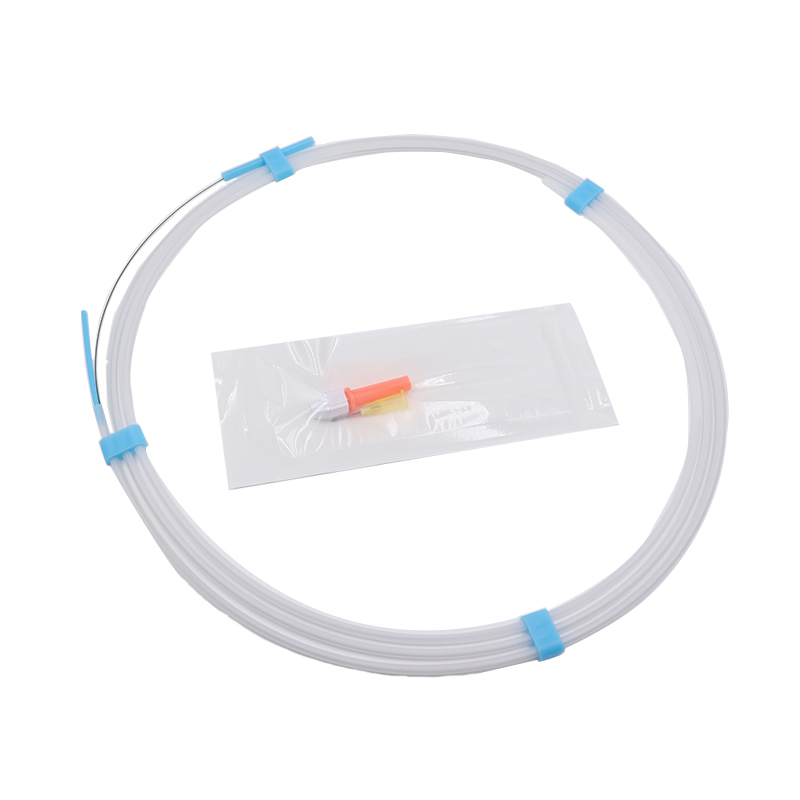
Main Types of Medical Guidewire
Medical guidewires can be categorized based on their primary clinical function, surface coating technology, and structural tip and core design.
1. By Primary Function
- Standard / Access Guidewires: Designed for general catheter placement, initial vascular access, and routine navigation. They offer a baseline balance of flexibility and support.
- Workhorse Guidewires: Ideal for everyday interventional procedures where a balance of steerability, tactile feedback, and pushability is required across standard vessel anatomies.
- Specialty & Super-Stiff Guidewires: Built to provide maximum column strength and support during heavy device delivery (such as stents, balloons, or large-lumen catheters) and catheter exchange procedures.
2. By Coating Type
- Hydrophilic Guidewires: Feature a specialized polymer coating that becomes ultra-slippery when activated by fluid (saline or blood). This significantly reduces friction, making them the gold standard for crossing tight lesions and navigating narrow or tortuous pathways.
- Hydrophobic Guidewires: Coated with materials like PTFE (Teflon) or silicone that repel fluids. They provide a predictable, tactile dry-friction feel, offering reliable control and smooth catheter tracking without requiring pre-hydration.
3. By Tip and Core Design
- Straight vs. Angled/J-Tip: Straight tips allow pinpoint axial advancement; Angled or J-tips minimize vessel trauma and assist in steerability through branching anatomy.
- Floppy vs. Stiff Tip: Floppy tips reduce trauma in delicate or fragile vessels, whereas stiffer tips assist in puncturing total occlusions or crossing calcified structures.
- Core Wire Taper & Material (Nitinol vs. Stainless Steel): Stainless steel core wire delivers superior pushability and 1:1 torque transmission, while a Nitinol core provides kink resistance and shape memory for complex curvature.
Classification of Medical Guidewires
| Classification Category | Subtype / Design | Primary Feature | Primary Clinical Application |
|---|---|---|---|
| By Primary Function | Standard / Workhorse | Balanced flexibility, support, and tactile feedback | General vessel access and routine navigation |
| Super-Stiff / Support | High column strength and resistance to bending | Heavy device delivery and catheter exchange | |
| By Coating Type | Hydrophilic Coating | Highly lubricious when wet; minimal tissue friction | Navigating tight, narrow, or tortuous pathways |
| Hydrophobic Coating (PTFE) | Predictable dry-surface tactile control and trackability | General catheter placement and direct guidance | |
| By Tip & Core Design | Angled / J-Tip Design | Atraumatic curved tip for steering through branches | Preventing vessel puncture; branching navigation |
| Nitinol vs. Steel Core | Kink-resistant Nitinol or high-torque Stainless Steel | Tortuous anatomical paths vs. strong pushability |
Common Applications of Medical Guidewire
Medical guidewires are used in many minimally invasive procedures because they provide a controlled pathway for catheters and other instruments.
- Vascular Procedures: In vascular intervention, a guide wire can help establish access and guide catheters through blood vessels. Guidewires may be used during angiography, vascular access, catheter placement, and other endovascular procedures.
- Cardiology: Guidewires are an important part of many interventional cardiology procedures. They can help physicians navigate catheters through blood vessels toward the heart and target vessels.
- Urology: In urological procedures, guidewires can help guide catheters and other instruments through the urinary tract (ureter, kidney, or bladder).
- Gastroenterology: Medical guidewires are used in certain gastrointestinal procedures to assist with catheter placement and device exchange, particularly involving bile ducts and related structures.
- Catheter Placement: One of the most common functions is assisting with catheter placement by providing a controlled route to the target location.
How to Choose the Right Medical Guidewire?
Choosing the appropriate guidewire depends on the procedure, anatomy, catheter, and required handling characteristics:
- Diameter: Must be compatible with the catheter and procedure.
- Length: Working length should be sufficient to reach the target location.
- Flexibility: Helps navigate curved or delicate anatomical pathways.
- Stiffness: Provides additional support for device delivery.
- Pushability: Allows controlled advancement from the proximal end.
- Torque control: Helps the operator control the direction of the distal tip.
- Coating: PTFE and hydrophilic coatings offer different surface lubrication characteristics.
- Tip design: Tip shape and stiffness affect navigation and procedural control.
- Catheter compatibility: Must align with the intended catheter or medical device.
For hospitals, distributors, and medical supply companies, product specifications and intended applications should always be reviewed before selecting a guidewire.
Why Is Guidewire Quality Important?
The quality of a medical consumable such as a guidewire can affect handling and procedural performance.
A well-designed guidewire should provide appropriate flexibility, reliable mechanical strength, consistent dimensions, and suitable surface characteristics.
For medical supply distributors, other factors may also be important, including manufacturing consistency, packaging, sterilization, regulatory compliance, available specifications, and OEM or ODM capabilities.
When sourcing guidewires, buyers should work with qualified medical device manufacturers and confirm that the product specifications match the intended clinical application.
Conclusion
A medical guidewire is an important device used to support catheter placement and navigation during many minimally invasive procedures.
Different guidewires offer different levels of flexibility, stiffness, support, lubricity, and torque control. Common options include standard guidewires, hydrophilic guidewires, PTFE guidewires, super-stiff guidewires, specialty guidewires, and GTCA guidewires.
Understanding the differences between guidewire materials, coatings, types, and applications can help healthcare providers and medical supply buyers select products that better match their procedural requirements. As an important category of medical consumables, guidewires should be selected according to product specifications, intended use, catheter compatibility, and applicable regulatory requirements.
Post time: Aug-18-2026