




Huber needles are specialized medical devices designed for safe and repeated access to implanted ports without damaging the silicone septum. As non-coring needles, they are widely used in chemotherapy, long-term infusion therapy, and other procedures involving implantable vascular access devices.
Among all available designs, there are two main types of Huber needles most commonly used in clinical practice: the straight Huber needle and the Huber needle with a 90 degree angle. While both serve the same fundamental purpose, their structure, stability, and ideal use scenarios differ significantly.
Understanding the differences between straight Huber needle vs Huber needle with a 90 degree angle helps healthcare professionals and medical device buyers select the most appropriate option for specific treatment needs.
Overview of the Two Main Types of Huber Needles
The primary distinction between these two types lies in needle orientation and how the device sits on the patient’s skin after insertion.
A straight Huber needle enters the implanted port vertically and remains upright.
A Huber needle with a 90 degree angle bends at a right angle, allowing the needle and housing to lie flat against the skin.
Both designs use non-coring needle tips to protect the implanted port septum, but each is optimized for different clinical situations.
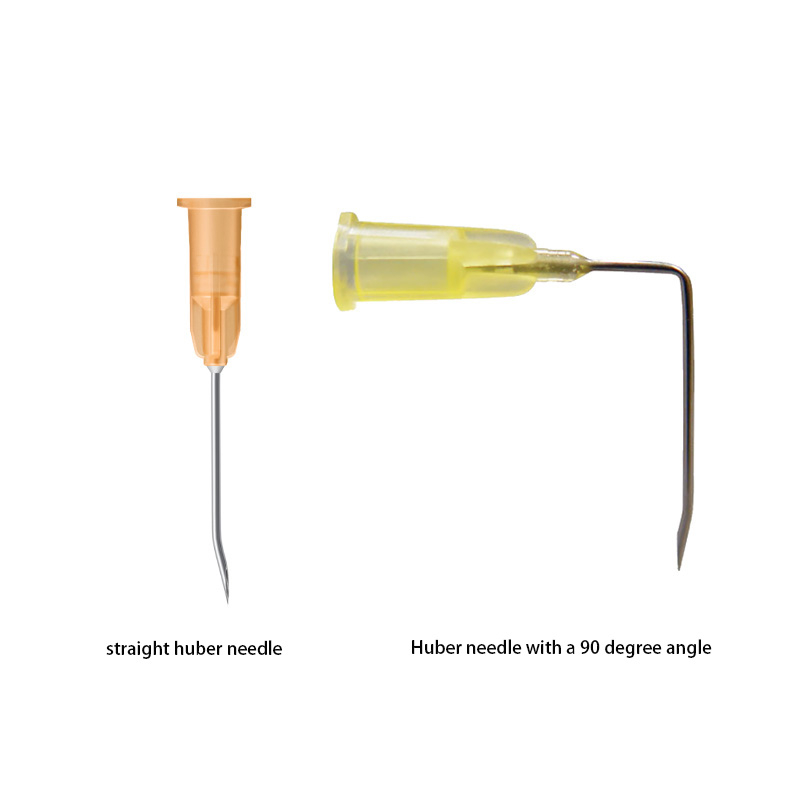
Straight Huber Needle: Uses, Benefits, and Limitations
A straight Huber needle is typically used for short-term or controlled procedures where patient movement is minimal.
Straight Huber needles are often used for:
Port flushing and routine maintenance
Blood sampling through implanted ports
Short-duration medication infusion
Diagnostic or inpatient procedures
Advantages
Simple and cost-effective design
Easy insertion and removal
Suitable for short procedures in controlled environments
Limitations
Less stable during patient movement
Not ideal for long-term or ambulatory use
May cause discomfort during extended infusion
Huber Needle With a 90 Degree Angle: Uses, Benefits, and Limitations
A Huber needle with a 90 degree angle is designed for enhanced stability and comfort, especially during long infusion sessions.
These needles are widely used in:
Chemotherapy administration
Long-term IV therapy
Parenteral nutrition
Outpatient and ambulatory infusion treatments
Advantages
Excellent stability and reduced risk of dislodgement
Improved patient comfort during long-term use
Low-profile design ideal for mobile patients
Limitations
Slightly higher cost compared to straight Huber needles
Requires proper training for accurate placement
Straight Huber Needle vs Huber Needle With a 90 Degree Angle: Key Differences at a Glance
To better understand how these two main types of Huber needles compare in real-world clinical settings, the following table summarizes their uses, advantages, disadvantages, and ideal application scenarios.
| Comparison Item | Straight Huber Needle | Huber Needle With a 90 Degree Angle |
| Primary Use | Short-term vascular access through implanted ports | Long-term or continuous access to implanted ports |
| Typical Applications | Port flushing, blood sampling, short infusions, diagnostic procedures | Chemotherapy, long-term IV therapy, parenteral nutrition, outpatient infusion |
| Needle Design | Straight, vertical shaft | Bent design with a 90 degree angle that lies flat on the skin |
| Stability During Use | Moderate; less stable if patient moves | High; designed to stay securely in place |
| Patient Comfort | Acceptable for short procedures | Superior comfort for prolonged infusion |
| Risk of Dislodgement | Higher, especially during movement | Lower due to low-profile design |
| Ease of Insertion | Very easy, simple technique | Requires proper training and positioning |
| Ideal Patient Scenario | Bed-rest patients or controlled clinical environments | Ambulatory patients or long-duration treatments |
| Cost Consideration | More cost-effective, basic design | Slightly higher cost due to complex structure |
| Recommended Clinical Setting | Inpatient wards, procedure rooms | Oncology departments, infusion centers, outpatient clinics |
How to Choose the Right Type of Huber Needle
When deciding between the two main types of Huber needles, healthcare providers and procurement teams should consider:
Expected infusion duration
Patient mobility and comfort requirements
Type of implanted vascular access device
Safety and stability needs
Budget and procurement strategy
For short, controlled procedures, a straight Huber needle is often sufficient. However, for chemotherapy or long-term infusion therapy, a Huber needle with a 90 degree angle is generally the preferred choice.
Conclusion
The straight Huber needle and the Huber needle with a 90 degree angle represent the two main types of Huber needles used in modern vascular access management. While both provide safe, non-coring access to implanted ports, they are optimized for different clinical applications.
Understanding the differences between straight Huber needle vs Huber needle with a 90 degree angle allows healthcare professionals and medical device buyers to make informed decisions, improve patient comfort, and ensure efficient use of vascular access devices.
Post time: Dec-29-2025