




A chemo port is only as usable as the needle that reaches it. Three decisions decide whether an access works: the gauge, which sets flow; the length, which has to match how deep the port sits; and the way the needle is held in place for the days it stays in. Most port-access problems trace back to one of those three rather than to the port itself.
This guide sets out what published port-care policies and FDA clearances actually specify for each, and ends with the fields a distributor or OEM buyer should fix before placing an order.
What a chemo port needle is
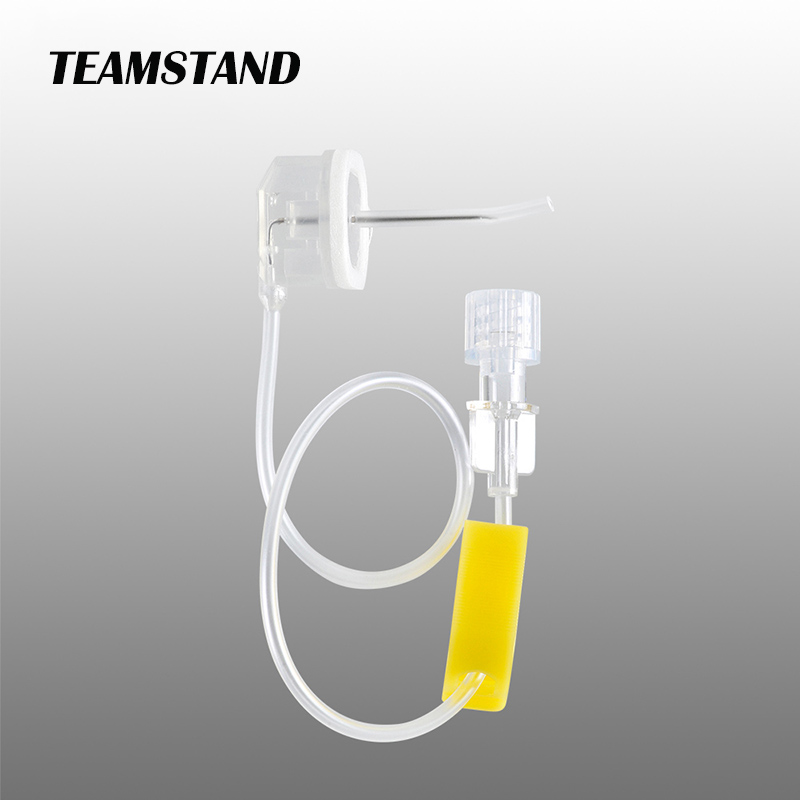
A chemo port needle is a non-coring needle with a right-angle housing, supplied as a set with extension tubing, a clamp and usually a Y-site. "Huber needle", "non-coring needle", "port needle" and "gripper needle" name the same device; the difference is regional and trade usage, not design. The full configuration range sits in our Huber needle types and sizes guide.
The point is deflected and back-cut, so it separates the silicone septum instead of cutting a plug out of it. That is the whole reason a port can be punctured repeatedly over months without leaking. A standard hypodermic needle removes material from the septum every time, and the septum is the one component that cannot be replaced without surgery. More on the mechanism is in coring vs non-coring needles.
Two configurations matter commercially. A straight needle stands upright and suits flushing, short procedures and blood sampling. A 90-degree needle lies flat against the skin, which is what makes multi-day dwell practical; the comparison is in straight vs 90-degree Huber needle. Chemotherapy, parenteral nutrition and outpatient infusion use the 90-degree form almost exclusively.
Gauge: choose by therapy, not by habit
Gauge sets two things at once — how fast fluid moves and how much trauma the septum takes. Published port-care policy is consistent on the direction: use the smallest gauge that still accommodates the ordered therapy.
The flow figures below come from FDA 510(k) summaries for Huber needle infusion sets and from a manufacturer sell sheet, which agree with each other. They apply to power injection through a port that is itself rated for it.
| Gauge | Hub color (ISO 6009) | Outer diameter | Power injection | Typical port use |
| 19G | Cream | 1.1 mm | 5 mL/s at 325 psi | Blood products, rapid infusion, apheresis |
| 20G | Yellow | 0.9 mm | 5 mL/s at 325 psi | Standard chemotherapy infusion, blood draws |
| 21G | Green | 0.8 mm | Within the 19G–22G power range; rate not stated separately | Routine infusion, smaller volumes |
| 22G | Black | 0.7 mm | 2 mL/s at 325 psi | Slower infusion, fragile or small access |
| 23G | Blue | 0.6 mm | Not for power injectors | Low-volume infusion, pediatric |
| 24G | Medium purple | 0.55 mm | Not for power injectors | Small volumes, neonatal |
| 25G | Orange | 0.5 mm | Not for power injectors | Delicate access, very low volume |
Two things in that table are worth more attention than the rest.
19G and 20G are not interchangeable with 22G for contrast studies. A CT injection at 5 mL/s through a 22G needle is outside the cleared condition; the 22G figure is 2 mL/s. If your customer's radiology department injects at a fixed protocol rate, the gauge has to be chosen against that rate, not against infusion habits.
24G and 25G must not be used with a power injector at all, regardless of the port. This is stated in the clearance text, and it is worth checking in any catalog that prints "power injectable" across every gauge.
For routine chemotherapy the practical default is 20G, with 22G where the access is small or the rate is low. 19G is a flow decision, not a default: it makes a larger puncture and is chosen when volume matters. Where the therapy itself is the constraint — vesicant drugs, for instance — the gauge question and the pressure question are separate, and Huber needle vs power port needle covers where the two overlap.
The procurement consequence: gauge is a range, not a single SKU. A catalog that lists only 20G will lose orders to a distributor who can supply 19G through 22G in the same tubing length, because hospitals stock by protocol rather than by preference.
Length: match the port, not the patient
Length is the specification most often chosen by eye, and the one that fails most quietly.
Suppliers commonly offer 0.5, 0.75, 1.0, 1.25 and 1.5 inch, roughly 13 mm to 38 mm. The correct length is the one where the wings sit level with the skin and the needle tip rests against the back of the reservoir. Published port-care policy states that criterion directly: the external components should sit level with the skin with the needle firmly seated in the port.
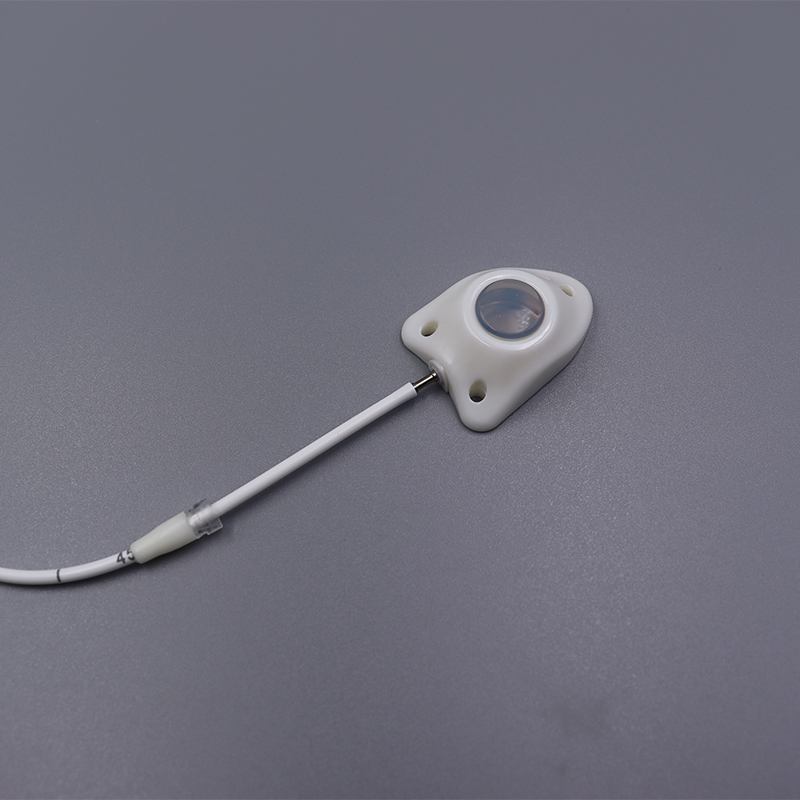
That gives two failure modes, and they are not symmetrical:
- Too short. The tip does not clear the septum, so the needle appears seated but the lumen is partly in the septum. Flow is sluggish, blood return is poor, and a vesicant can leak into tissue around the port instead of into the reservoir.
- Too long. The needle stands proud, the housing rocks on the skin, and movement is transmitted to the septum. That is a dislodgement and a septum-damage risk at the same time.
Depth is not a fixed property of a patient. It changes with weight, and it changes with the pocket the surgeon made, so a patient who gains or loses weight may need a different length without any change to the port. This is also why a single-length kit sells well in some markets and badly in others: where access is performed by a dedicated team, they tend to stock a length range; where it is ad hoc, buyers tend to settle on one length and accept the mismatch.
Dwell time: seven days is a policy number
The needle is not designed to stay indefinitely. Published port-care policies converge on the same limit: for continuous or daily use, the non-coring needle may remain in place for up to 7 days, and the needle and its dressing are then changed together. Patient information from a hospital group states the same rule from the other direction — port needles are changed at least every 7 days and should only remain in place while the port is being used.
Three qualifications matter more than the number itself.
Dwell is set by the facility, not by the needle. The 7-day figure comes from infusion policy and its underlying standards; it is not a property of a particular product. Two hospitals can run different rules on the same SKU, and the port itself is designed to be accessed for years — see how a chemo port works for where the needle stops and the device begins.
The device label can be shorter than the policy. At least one cleared safety Huber needle is indicated for use "up to 24 hours", while policies at the facility level allow far longer for continuous access. That gap is a real problem for a distributor: if your catalog or IFU says something different from the customer's protocol, the customer will notice at audit. Confirm what your own IFU states before quoting a dwell figure.
Some situations require changing the needle immediately, not at day seven. Published guidance lists the same triggers: signs of infection at the site, loss of blood return or a flush that meets resistance, any evidence the needle has moved or is leaking, and a dressing that is wet, peeling or no longer occlusive. A needle that has been displaced must not be used for a vesicant, because the drug may be going into tissue rather than into the reservoir.
For the product side, the practical implication is labeling. If the IFU states a duration of use, the packaging, the catalog entry and the sales sheet all have to say the same thing, and the tubing clamp has to be adequate for a line that stays clamped between uses.
Fixation: what keeps the needle seated
A port needle is held by dressing and by geometry, not by the septum alone. Published port-care policy is specific about both.
The dressing. A sterile transparent semipermeable membrane dressing covers the access site. It is changed every 7 days together with the needle. If gauze is placed over the needle and site, the dressing interval shortens to every 2 days. If gauze is used only to support the wings of the needle under the transparent dressing, the 7-day interval can be kept — provided the insertion site stays visible and can be assessed. The site must always be visible; a dressing that hides it defeats the purpose.
The geometry. The wings sit level with the skin and the needle is seated against the back of the reservoir. That is the same criterion used to choose the length, which is why length and fixation are one decision rather than two. A chlorhexidine-impregnated disc, where used, goes around the needle and is handled with sterile gloves only.
The tubing. For patients who shower, the extension tubing exits the dressing at the bottom, so water runs away from the site rather than under the dressing. When the port is accessed but not in use, the line stays clamped.
The bevel. The non-coring bevel is oriented away from the outflow channel — the side where the catheter joins the port body — which improves flow during flushing. It is a small detail that distributors are rarely asked about and that appears in every serious port-care policy.
What this means for a buyer is unglamorous but concrete: the set has to include a clamp that actually occludes, tubing long enough to reach a pump without tension, and a housing whose wings accept either tape or a stabilization device without lifting the needle. This is where inexpensive sets tend to fail first — a stiff clamp or short tubing pulls on the housing, and the pull is transferred straight to the septum.
What to specify when you order
Most order errors on this product are configuration errors, not quality errors. The following fields are worth fixing in writing before a batch is scheduled.
| Field | What to state | Why it matters |
| Gauge range | 19G–22G for power-capable markets; add 23G–25G where pediatric or neonatal demand exists | One gauge cannot serve both flow and fragility |
| Length range | At least 0.75, 1.0 and 1.25 inch; 0.5 inch for lean or pediatric patients | Length must track port depth, which varies by patient |
| Y-site | With or without, and the connector type | Determines secondary access and the price point |
| Safety mechanism | Passive on withdrawal or manual activation | Facilities with a needlestick policy will ask which one |
| Tubing length and clamp | State both numerically | The most common cause of a rejected sample |
| Color coding | Per ISO 6009, matching gauge | Hospitals cross-check color against gauge at the bedside |
| Duration of use on the label | State what the IFU says | Must not contradict the customer's protocol |
| Sterilization and shelf life | EO, SAL 10⁻⁶, dated expiry | Required for tender documentation |
| Packaging | Individual pouch, box count | Ward-level stock control |
| MOQ and configuration lock | MOQ 100,000 pieces, configuration fixed at order | Custom labeling cannot be changed mid-batch |
That last row is the one buyers underestimate. On a made-to-order program the gauge mix, tubing length and label artwork are fixed when the batch is scheduled, not when the goods ship. Getting the matrix wrong means either a batch nobody ordered or a reprint.
Our own Huber needle sets are produced to order at MOQ 100,000 pieces, with configuration, packaging and labeling fixed at the time of order. The range is on the chemo port needle product page; the port side is on the implantable port kit page.
19G to 22G covers most chemo port access, with 20G the usual default for infusion and 22G where the access is small or the rate is low. Length is chosen separately, so that the wings sit level with the skin and the tip rests against the back of the reservoir.
Up to 7 days for continuous or daily use under published port-care policy, with the needle and dressing changed together. Dwell is a facility policy decision, so the device IFU and the local protocol both have to be checked — some clearances state a shorter duration of use.
Yes. Huber needle, non-coring needle, port needle and gripper needle describe the same right-angle, non-coring device. The naming varies by region and trade usage, not by design.
Yes, at up to 2 mL/s at 325 psi, through a port rated for power injection. The 19G and 20G versions are cleared to 5 mL/s at the same pressure. 24G and 25G must not be used with a power injector.
With a sterile transparent semipermeable dressing changed every 7 days along with the needle, wings level with the skin, tubing exiting at the bottom and clamped when the line is idle. Gauze over the site shortens the dressing interval to every 2 days.
Gauge and length ranges, Y-site and connector type, safety mechanism, tubing length and clamp, ISO 6009 color coding, the duration of use printed on the label, sterilization and shelf life, and the MOQ with the configuration lock date.
WANT TO WORK WITH US?

Author: EMMA
Marketing Manager
Hello, I'm Emma, serving as the Marketing Manager at Shanghai Teamstand Corporation. With over 10 years' experience in the medical industry. Our dedicated team is eager to offer you good service and high quality products with competitive price.
Mob: (00)86-18621901943
Email: sales@teamstandmed.com
Post time: Nov-09-2026